Humanoid and legged robots
Learned locomotion and whole-body control on the Unitree G1 and Go2.
I build humanoid robots, legged robots, robot arms, mobile robots and arms for spacecraft, and I train robot learning policies.
Following my PhD at the National University of Singapore, I build robots end to end: CAD and circuit boards, firmware and ROS 2, simulation and learned control.
Learned locomotion and whole-body control on the Unitree G1 and Go2.
An arm I built from scratch, two-arm learning platforms, and arms on free-floating spacecraft.
SLAM and Nav2 on robots I designed, including one that rides lifts between floors.
People tracking from 2D LiDAR, imitation and reinforcement learning, language-conditioned policies.
A Unitree G1 driven by a vision-language-action model over the SONIC whole-body controller. Trained on an 82-episode head-camera dataset I generated in simulation.
Dataset: 82 validated episodes, 27,915 frames, 55 tasks. Push recovery: a 320 N lateral shove, and the G1 stays up.
Guides visitors across a building: it calls the lift, rides it and switches maps on arrival. Tested in real buildings.
6-DOF arm: I did the CAD, the PCB, the printing and the ros2_control driver. MoveIt 2 plans, MoveIt Servo jogs it in real time.
Differential-drive base with a Raspberry Pi 5 for ROS 2 and a Portenta H7 for motor control. LiDAR and IMU SLAM, Nav2, and a Gazebo model that matches it.
People detected and tracked from 2D laser scans only, using a U-Net segmenter. Runs on the target hardware.
PPO locomotion with push recovery, then a walk-to-run policy up to 3 m/s driven through unseen scenes by LiDAR mapping and A*.
30 of 30 navigation goals reached across four unseen scenes, 383 m in total, no falls; 3.8 m/s peak on the park loop.
A 7-joint arm on a free-floating 12U servicer tracking tool poses while the bus holds its pointing, and an orbit and attitude simulator with a CubeSat arm.
Simulator checks over 24 h of simulated time: relative energy drift 2.6e-12, angular-momentum drift 1.3e-12, maximum position error 0.08 mm.
Two PiPER arms and three RGB-D cameras for reinforcement learning on stacking and sorting, with a planner as fallback when the policy misbehaves.
PhD, robotics, control and intelligent systems (in progress)
Thesis: AI for space-based optical surveillance. Faint object detection in star-tracker imagery, attitude estimation and angles-only orbit determination.
BSc (Hons), Electronic and Telecommunication Engineering
Robotics, embedded systems and machine vision; competition robots for SLRC and RoboRoarZ.
Robotics research intern
Multi-robot platform for autonomous exploration, mapping and localisation of unknown environments; line-of-sight exploration algorithms and inter-robot coordination for collaborative mapping.
arXiv:2412.20376
Infers obstacles hidden behind occlusions from how nearby people move, so a robot in a crowd can react before its own sensors see them.
Algorithms for the Smorphi reconfigurable robot; concepts for disaster response.
Tower of Hanoi solved with custom manipulators; maze solving and line following.
Prototype for generating hydrogen from tidal waves; a year of research.
Autonomous robot for the finals tasks: floor pattern, wall following, radar, transmitter.
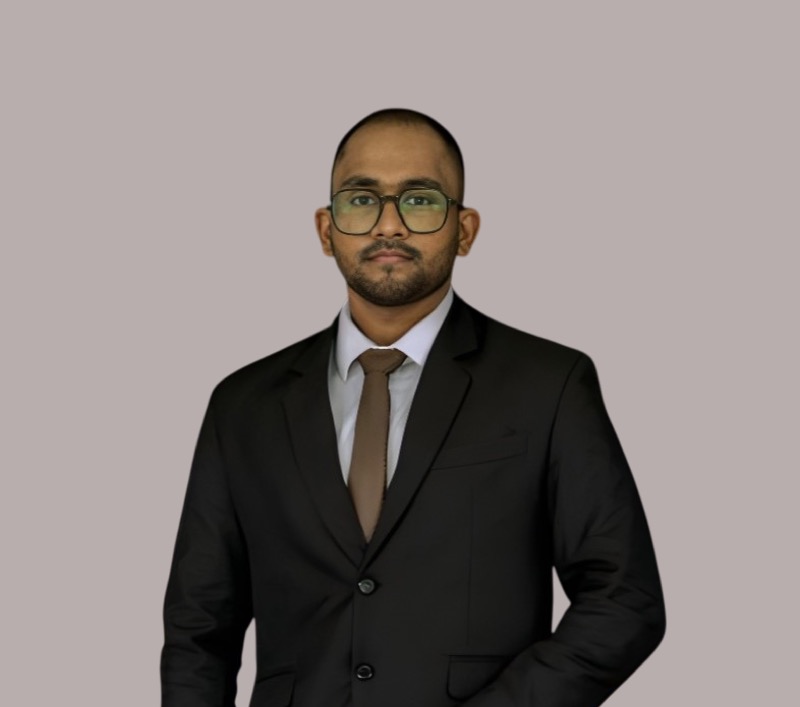
I started with competition robots at school and studied Electronic and Telecommunication Engineering at the University of Moratuwa. After a robotics internship at SUTD I moved to the National University of Singapore, where my PhD is on AI for space-based optical surveillance.
Outside the thesis I keep building robots. I prefer to own the whole machine: the CAD, the PCB, the firmware, the ROS 2 stack and the learned controller on top.
